Xeriscaping and Fire-Wise Landscaping in Prescott, AZ
Landscaping in the Prescott area is a balancing act. You want a yard that looks good and stays green enough without running the water bill up, and in our high-desert country you also have to think about wildfire. The good news is that water-wise and fire-smart landscaping go hand in hand, and with a little planning you can have a yard that is beautiful, low-maintenance, and safer for your home.
What xeriscaping is and why it fits Northern Arizona
Xeriscaping is landscaping built around low water use. Instead of thirsty turf and plants that struggle in our climate, it leans on native and drought-tolerant species, smart soil and gravel choices, and efficient watering. It is not a yard of bare rock and cactus. Done well, it is a full landscape with color, shade, and texture that simply happens to sip water instead of gulping it.
Northern Arizona is a strong fit for this approach. Towns like Prescott, Prescott Valley, and Mayer sit at elevation with rocky soil, hot dry summers, cold winters, and a short but intense monsoon season. Plants that evolved for this climate shrug off conditions that would kill a lawn, and once they are established they need very little from you.
- Lower water bills and less waste
- Plants that thrive instead of fighting the climate
- Less mowing, trimming, and constant upkeep
- A natural fit with fire-smart design
Planning a water-wise yard
Good xeriscaping starts on paper, not at the nursery. The idea is to group your yard into zones based on how much water each area needs, so you are not watering the whole property as if it were one big flower bed.
Think in watering zones
A simple way to plan is to picture three bands moving out from the house. Keep the higher-water, greener plantings closer to patios and entries where you spend time, step down to moderate-water shrubs and accents in the middle, and let the outer edges be the toughest, lowest-water native plantings. This keeps your effort and water where they do the most good.
Gravel, mulch, and soil
Ground cover does a lot of quiet work in a dry climate. Decomposed granite and gravel hold down dust, slow evaporation, and give the yard a clean high-desert look. Around trees and shrubs, a layer of mulch keeps roots cooler and the soil moist longer.
- Use gravel and decomposed granite for paths and open areas
- Mulch planting beds to cut evaporation
- Loosen and amend rocky soil where you want plants to root
Native and drought-tolerant plants
Choosing plants suited to our elevation is the single biggest factor in a yard that survives. Look for species that handle both summer heat and winter freezes.
- Flowering accents like penstemon, salvia, and desert marigold
- Shrubs such as manzanita, Apache plume, and rabbitbrush
- Grasses and agave or yucca for structure
- Hardy shade trees placed with their mature size in mind
Drip irrigation basics
Even drought-tolerant plants need regular water for their first year or two while roots establish. Drip irrigation is the most efficient way to deliver it. Instead of spraying water into the air where much of it evaporates, drip lines put water right at the base of each plant, slowly enough that the soil can absorb it.
A basic system runs from a hose bib or valve through tubing, with small emitters placed at each plant. Add a timer and the yard largely waters itself on a schedule you set.
- Water deeply and less often to push roots down
- Water early in the morning to limit evaporation
- Check emitters each season for clogs and leaks
- Scale back watering once plants are established
A well-designed drip system pays for itself in saved water and healthier plants, and it is easy to expand as your landscape grows.
Fire-wise and defensible-space landscaping
Wildfire is a real concern across Northern Arizona, and landscaping is one of your best tools for protecting a home. Fire-wise design, often called defensible space, means arranging plants and materials so a fire has less fuel to carry toward the house. It is not about stripping your lot bare. It is about being thoughtful with what grows where.
Work in zones out from the house
- Keep the first few feet around the home lean, using gravel, pavers, and hardscape rather than shrubs against the walls
- In the next zone, space plants apart so flames cannot jump easily from one to the next
- Farther out, thin brush and keep grasses low
Reduce fuel and keep it up
- Remove dead branches, leaves, and needles regularly
- Trim tree limbs up off the ground and away from the roof
- Store firewood and propane away from the house
- Choose lower-resin, higher-moisture plants near structures
The happy overlap is that water-wise choices like gravel, spaced plantings, and masonry are also fire-smart choices. One plan gets you both.
Hardscape and masonry for rocky high-desert lots
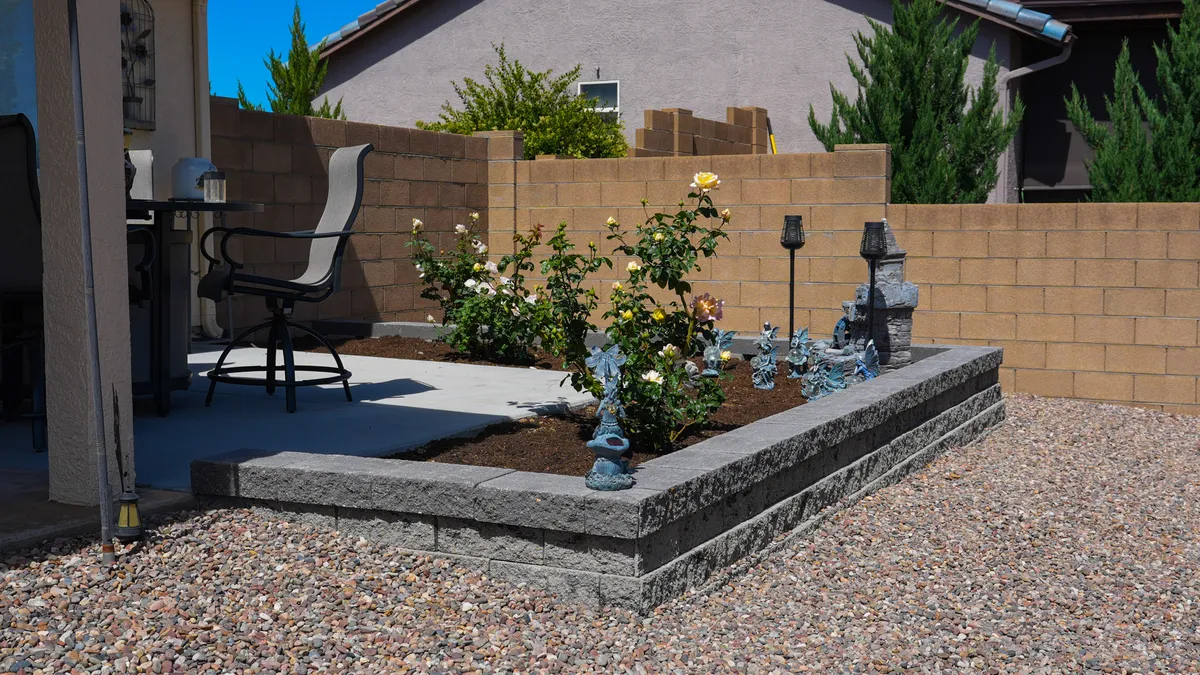
Many lots around Prescott and Mayer are sloped and rocky, which is exactly where good stonework and masonry earn their keep. Hardscape gives structure to a yard, solves drainage and grade problems, and creates usable outdoor living space, all with surfaces that need no water and will not burn.
This is a strength of our team. We have a master mason on staff, so retaining walls, patios, and block work are handled in-house and built to last.
Where hardscape makes the difference
- Retaining walls to terrace a slope and control erosion
- Paver patios and walkways for durable, low-maintenance living space
- Block and privacy walls that hold up to weather and double as fire breaks
- Dry creek beds and gravel swales to manage monsoon runoff
On a rocky high-desert lot, solid masonry is often the foundation the rest of the landscape is built around. Get the walls and grading right and the planting becomes the easy part.
Low-maintenance upkeep
One of the best things about a well-built xeriscape is how little it asks of you once it is in. There is no weekly mowing and no fighting plants that were never meant for this climate. The upkeep that remains is light and seasonal.
- A seasonal check of the drip system and timer
- Occasional pruning and removal of dead growth, which also keeps the yard fire-wise
- Refreshing gravel or mulch every few years
- A quick weed pass after the monsoon
Spend a little time each season and the yard largely takes care of itself, looking sharp year-round while using a fraction of the water a traditional lawn would.
Ready to plan your Northern Arizona yard?
Vets 1st of Arizona is a veteran-focused general contractor serving Prescott, Prescott Valley, Sedona, Cottonwood, Mayer, and Flagstaff, and we build water-wise, fire-smart landscapes with the masonry and hardscape to back them up. We offer a free phone quote to talk through your project, and a $75 on-site estimate that is credited toward your project when you move forward. Reach us at (928) 776-3020. Licensed KB-1 Dual Building Contractor, ROC #359130.